{"componentChunkName":"component---src-templates-blogpost-tsx","path":"/blog/edtech-is-being-called-the-new-fintech","result":{"pageContext":{"isCreatedByStatefulCreatePages":false,"id":"c139914c-3ad3-5fff-9289-5696af1bff0a","title":"EdTech is Being Called the ‘New FinTech’ - Why Are We Comparing Them?","slug":"edtech-is-being-called-the-new-fintech","published":"2017-08-23T00:00:00.000Z","author":"Dan Whale","content":"\n### FinTech firms need to seize the opportunity that EdTech is presenting them with, not attempt to compete.\n\nEducation technology is evolving rapidly. If you type ‘EdTech’ into a search engine, it will not take you long to find a plethora of [articles](https://techcrunch.com/tag/edtech/) describing it as the ‘next big thing’. There are currently over 1,000 EdTech firms in the UK[1](https://techcrunch.com/2016/08/13/edtech-is-the-next-fintech/) and investment is set to reach a massive $252 billion by 2020, growing 17% per annum.[2](https://www.uktech.news/news/report-edtech-spend-will-reach-252bn-2020-20160526)\n\nSo what is causing this surge? [KnowledeMotion](http://www.boclips.com/)’s David Bainbridge offers theories to explain why EdTech ‘is poised to be the biggest and most profitable digitized sector yet’. Bainbridge claims that education is changing in a way that has not been seen in 150 years, motivated by the new tech savvy generation of students adopting tablets and laptops whilst teachers utilise screens and interactive/cloud-based resources to help them teach.\n\nFurthermore, this new emerging sector generates $5 trillion globally per annum and is a relatively safe bet for investors. Compared to FinTech, it does not have the volatility of financial markets, and in a world currently dealing with Brexit, that has a big appeal. The investment opportunity that EdTech provides cannot be ignored.\n\nBut despite its deserved attention, many articles focus on EdTech being the successor to FinTech.[3](https://www.timetoknow.com/edtech-is-the-new-fintech/), [4](http://www.cityam.com/264160/first-came-fintech-now-edtech-set-revolutionise-corporate) We ask, why? EdTech and FinTech shouldn’t try to compete, they should be partnering.\n\n### EdTech & FinTech: The emerging opportunity\nThe education sector faces various problems that are not seen in many other industries and, unlike FinTech, technology is not enough to lead EdTech where it needs to go.\n\nOne example of this is handling money. \n\nImagine, for example, that as a student you receive extra-curricular guitar lessons. The school provides a teacher and the pupil pays for the service of the lesson. However, it is not usually the student that is paying. It is their parent or guardian, as most young students do not own bank accounts. This means the teacher has to accept payments in the form of cash in envelopes, send cheques or hope the school has some sort of payment system integrated on its website.\n\nThis example is seen many times over in schools: field trips, school dinners, sports clubs. There are payments going between students and the school every day, yet many schools still have no system for processing payments efficiently, securely and affordably.\n\nWhilst payments are commonplace in schools, they are still essentially viewed as admin and are much more onerous than needs be.\n\nUnlike normal businesses, the taking of money is not the endpoint. Schools, rightly so, divert the little time and resources they have to improving the quality of education and school life, which is why EdTech is on the rise but the opportunities FinTech can offer are being missed in education.\n\nEdTech systems should start to incorporate a payments option to their product. That way, one unified system that schools would be willing to adopt due to its positive impact on school life would at the same time massively improve their payment processing.\n\n### EdTech and FinTech: The perfect partnership\n\nThe emerging EdTech products and tools enable schools to save time, raise standards and increase engagement between teachers, parents/guardians and students; sequentially creating a positive impact across the entire education spectrum.\n\nWith The Paybase Platform, these organisations can extend their solutions to handle all aspects of payments electronically, easily, quickly and cost effectively. Schools will no longer have the pain of handling and reconciling cash from parents/guardians, instead they will have full control of all payments from meals, trips, clubs and tutors, seamlessly, effortlessly and instantly.\n\nThe [Paybase Platform](https://paybase.io/) is perfect for any EdTech apps/products that require a payment solution. With our platform they are able to fully automate and customise use-case-dependent payment options, reduce operational burden and potentially complex reconciliation through Integrated Electronic Payments. With built-in compliance and quick & simple integration through our unified API, payments between parents and schools suddenly become easy, instant and totally secure.\n\nIf you’re an EdTech firm or building something new that needs a payments option, we want to talk to you! Please get in touch with any questions or suggestions, or follow us:\n\n[Twitter](https://twitter.com/paybase) [LinkedIn](https://www.linkedin.com/company/paybase/) \n","excerpt":"\nFinTech firms need to seize the opportunity that EdTech is presenting them with, not attempt to compete.\n\nEducation technology is evolving rapidly. If you type ‘EdTech’ into a search engine, it will not take you long to find a plethora of articles d...","cover":{"src":"https://paybase.imgix.net/blog/fintech-and-edtech-the-perfect-partnership.jpg","alt":"need one"},"link":{"to":"/blog/edtech-is-being-called-the-new-fintech","copy":"Read more"},"tags":["EdTech","FinTech","Payments"],"related":[{"id":"acf16abc-9731-571f-b470-6881d7e01160","title":"Top FinTech Jargon Buster by Paybase","slug":"top-fintech-jargon-buster-by-paybase","published":"2017-07-26T00:00:00.000Z","author":"Ellie Fryer-Amblr","content":"\nWe’ve all been there. You’re part of a conversation which seems very interesting, but without knowing a few keywords, you have absolutely no idea what is going on. Sound familiar?\n\nA good area to brush up on would be FinTech, considering that its growth can be described as somewhat [mind-blowing](http://www.nordicstartupbits.com/2016/05/04/10-statistics-fintech-will-blow-mind/). Luckily for you, the [Paybase](https://paybase.io/) team have produced this jargon-busting guide to ensure that when FinTech (or more precisely the world of eMoney) comes up at the next dinner party, you can confidently stand your ground!\n\nWe’ve even jam packed the jargon buster into a social, friendly, sharable infographic.\nFree for you to save it and share it as you fancy.\n\n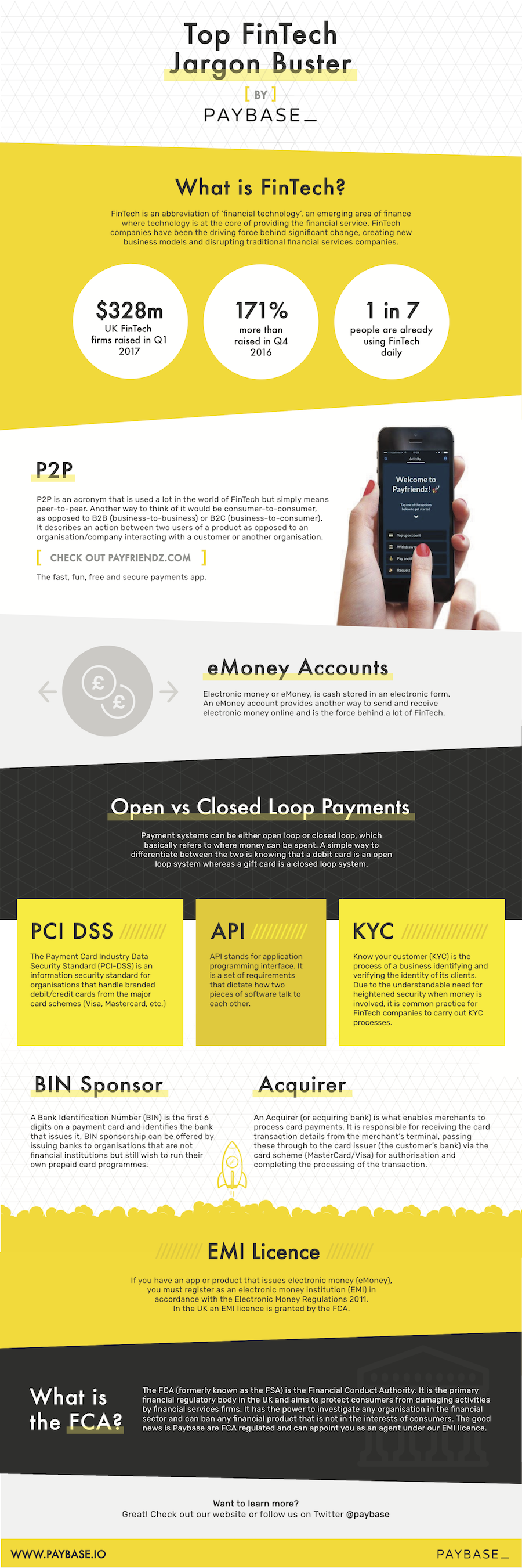\n[FinTech Jargon Buster by Paybase]\n\n## What is FinTech?\nFinTech is an abbreviation of ‘financial technology’, an ever emerging area of finance where technology is at the core of providing the financial service. FinTech companies have been the driving force behind significant innovation in finance, creating new business models and disrupting traditional financial service companies. According to [TechCityNews](http://techcitynews.com/2017/04/26/vc-funding-into-uk-fintech-rose-during-q1-2017/), UK FinTech firms raised $328m in Q1 2017, that is 171% more than raised in Q4 2016. It’s not surprising that about [1 in 7](http://uk.businessinsider.com/ey-statistics-on-fintech-usage-2016-1) people are already using FinTech in their daily lives in some way, shape, or form.\n\n## P2P\n[P2P](https://techterms.com/definition/p2p) is an acronym that is used a lot in the world of FinTech but simply means peer-to-peer. Another way to think of it would be consumer-to-consumer, as opposed to B2B (business-to-business) or B2C (business-to-consumer). It describes an action between two users of a product as opposed to an organisation/company interacting with a customer or another organisation. Examples of this can be [P2P payments](http://www.investinganswers.com/financial-dictionary/personal-finance/person-person-payments-p2p-2584), [P2P lending](http://www.investopedia.com/terms/p/peer-to-peer-lending.asp) and [P2P software](http://www.zonealarm.com/blog/2014/06/what-need-know-about-peer-to-peer-file-sharing/).\n\n
\n \n
[The Payfriendz App]
\n
\n\nCheck out our very own P2P payments app: [Payfriendz](https://www.payfriendz.com/) - The fast, fun, free and secure payments app.\n\n## EMoney Accounts\n[Electronic money](https://www.lexisnexis.com/uk/lexispsl/financialservices/synopsis/96451:96453/Payments-and-fintech/E-money?wa_origin=gnb) or eMoney, is cash stored in an electronic form. An eMoney account provides another way to send and receive electronic money online and is the force behind a lot of FinTech.\n> ‘EMoney infrastructure allows for the easy opening of eMoney accounts – lightweight financial instruments – in-app or directly on your website. This makes it perfect for [escrow](http://economictimes.indiatimes.com/definition/escrow-account)-like accounts, peer-to-peer-transactions and attached physical prepaid cards to name but a few applications. This is because, with eMoney, individual balances are recorded in an electronic ledger, whilst all funds are held in one single bank account.'\n>\n> Anna Tsyupko CEO, Paybase ([interview](https://startacus.net/culture/the-key-challenges-of-building-payments-into-your-app#.WXcectPyvUI) discussing eMoney infrastructure).\n\n## Open vs Closed Loop Payments\nPayment systems can be either [open loop or closed loop](http://www.intelligentvenues.com/faqs/what-are-the-differences-between-open-and-closed-loop-payment-systems/), which basically refers to where money can be spent. A simple way to differentiate between the two is knowing that a debit card is an open loop system whereas a gift card is a closed loop system.\n\n• Open loop: Open loop systems are linked to a personal account so do not need to be topped-up. Users can pay at many different locations from one payment device.\n\n• Closed loop: Money is loaded onto a payment device which is used for one specific purpose. [Source](http://www.intelligentvenues.com/faqs/what-are-the-differences-between-open-and-closed-loop-payment-systems/)\n\n## PCI DSS\nThe Payment Card Industry Data Security Standard ([PCI-DSS](https://www.pcisecuritystandards.org/pci_security/)) is an information security standard for organisations that handle branded debit/credit cards from the major card schemes (Visa, Mastercard, etc).\n\nAs set out by [PCI security standards](https://www.pcisecuritystandards.org/pci_security/), ‘we serve those who work with and are associated with payment cards. This includes: merchants of all sizes, financial institutions, point-of-sale vendors, and hardware and software developers who create and operate the global infrastructure for processing payments.’\n\nThe Standard has two main priorities:\n\n• Helping merchants and financial institutions understand and implement standards for security policies, technologies and ongoing processes that protect their payment systems from breaches and theft of cardholder data.\n\n• Helping vendors understand and implement standards for creating secure payment solutions.\n\nPCI DSS has 12 high level requirements for compliance which fall into [six categories](http://www.theukcardsassociation.org.uk/security/what_is_PCI%20DSS.asp). Regular monitoring and maintenance are required to comply fully. The good news is if you partner with Paybase you do not need to comply with PCI requirements as Paybase is PCI compliant and takes this responsibility away from you. Find out more [here](https://paybase.io/)\n\n## API\nAPI stands for application programming interface. It is a set of requirements that dictate how two pieces of software talk to each other. An easy way to think of it is using [Mulesoft's](https://www.mulesoft.com/platform/api) analogy of an API being similar to the waiter in a restaurant.\n\n> It is their job to offer you the menu, take your order to the kitchen, tell the kitchen what you want and finally deliver what you ordered to your table. The waiter acts as the ‘API’ that allows you and the kitchen to communicate.\n\nThey have a great video that gives a helpful explanation if you would like to know more!\n\n\n[[Source](https://www.mulesoft.com/platform/api)]\n\n## KYC\n[Know your customer](https://en.wikipedia.org/wiki/Know_your_customer) (KYC) is the process of a business identifying and verifying the identity of its clients. Due to the understandable need for heightened security when money is involved, it is common practice for FinTech companies to carry out KYC processes.\nAccording to [RealWire](https://www.realwire.com/releases/Typical-UK-bank-will-waste-10m-annually-on-inefficient-KYC-checks) a typical UK bank will waste £10m annually on inefficient KYC- checks. The report finds that mobile technology could save £5million in KYC costs, rising to £10 million in three years.\n\n## BIN Sponsor\nA Bank Identification Number (BIN) is the first 6 digits on a payment card and identifies the bank that issues it. [BIN sponsorship](https://www.paysafe.com/cardsolution/prepaid-solutions/bin-sponsorship/) can be offered by issuing banks to organisations that are not financial institutions but still wish to run their own prepaid card programs.\n\n## Acquirer\nAn [Acquirer](https://en.wikipedia.org/wiki/Acquiring_bank) (or acquiring bank) is what enables merchants to process card payments. It is responsible for receiving the card transaction details from the merchant’s terminal, passing these through to the card issuer (the customer’s bank) via the card scheme (MasterCard/Visa) for authorisation and completing the processing of the transaction.\n\n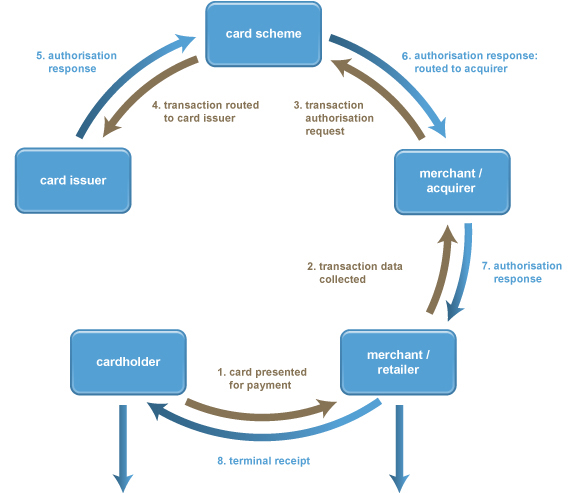\n[Payment cycle diagram: [source](http://www.theukcardsassociation.org.uk/getting_started/card-payment-cycle.asp)]\n\nThe acquirer will arrange the card transaction’s settlement and will typically credit the merchant’s nominated bank account with the funds in accordance with the service agreement. [Source](https://en.wikipedia.org/wiki/Acquiring_bank)\n\n## EMI Licence\nIf you have an app or product that issues electronic money (eMoney), you must register as an [electronic money institution](https://www.fca.org.uk/firms/apply-become-electronic-money-institution-emi) (EMI) in accordance with the Electronic Money Regulations 2011. EMIs need to comply with the Money Laundering, Terrorist Financing and Transfer of Funds (Information on the Payer) [Regulations 2017](http://www.legislation.gov.uk/uksi/2017/692/contents/made). In the UK an EMI licence is granted by the [FCA](https://www.fca.org.uk/firms/apply-become-electronic-money-institution-emi).\n\n## What is the FCA?\nThe [FCA](https://www.fca.org.uk/about) (formerly known as the FSA) is the Financial Conduct Authority. It is the primary financial regulatory body in the UK and aims to protect consumers from damaging activities by financial services firms. It has the power to investigate any organisation in the financial sector and can ban any financial product that is not in the interests of consumers.\nThe good news is Paybase are [FCA regulated](https://www.fca.org.uk/about/the-fca) and can appoint you as an agent under our EMI licence.\n\nSo there you have it! This is by no means an exhaustive list of FinTech terminology, but it should help you feel a little more clued-up when you’re next thrown into a conversation on finance/technology. However, if you want to really impress people, tell them about the amazing things [Paybase](https://paybase.io/) are doing to disrupt the sector! Feel free to drop us a line and we’ll fill you in.\n\n\nFollow us [Twitter](https://twitter.com/paybase) [LinkedIn](https://www.linkedin.com/company/paybase/) \n","excerpt":"\nWe’ve all been there. You’re part of a conversation which seems very interesting, but without knowing a few keywords, you have absolutely no idea what is going on. Sound familiar?\n\nA good area to brush up on would be FinTech, considering that its gr...","cover":{"src":"https://paybase.imgix.net/blog/people-confused-by-fintech-jargon.jpg","alt":"need one"},"link":{"to":"/blog/top-fintech-jargon-buster-by-paybase","copy":"Read more"},"tags":["FinTech","Payments","Jargon"]},{"id":"e86bdb62-c535-56f1-9578-7fbe6a691c20","title":"Paybase presents Blind Date","slug":"valentines-blind-date","published":"2020-02-14T00:00:00.000Z","author":"Gemma Doswell","content":"How well do you know your industry? We’re putting you to the test in a very special FinTech edition of Blind Date. See if you can match these seven FinTech Valentine’s hopefuls with their perfect features, terms and instruments. The more you get right, the more you can be certain that you have the critical knowledge and innovation to disrupt your industry.\n\nGood luck, and happy match-making! Check your answers at the bottom of the page.\n\n\n\n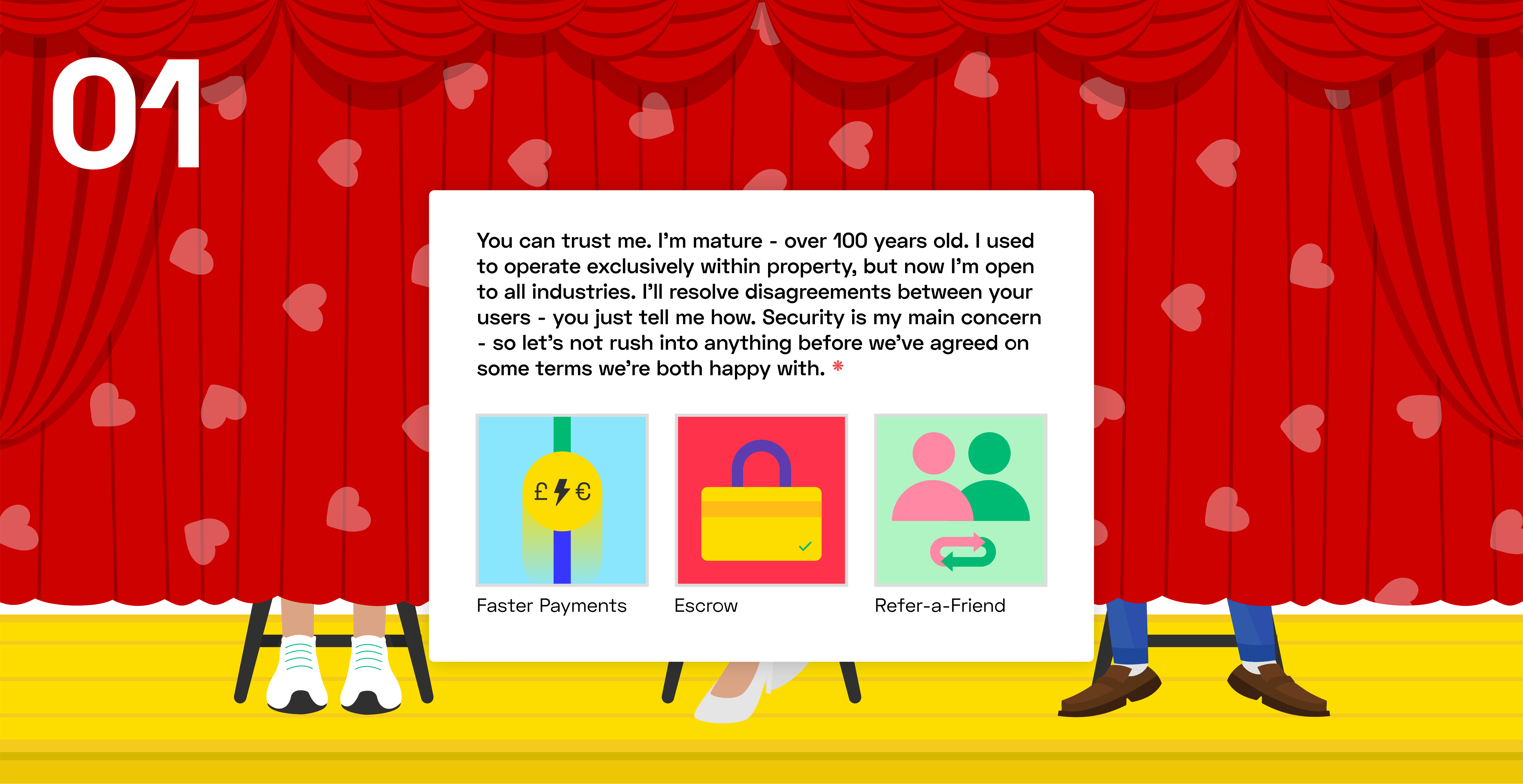\n\n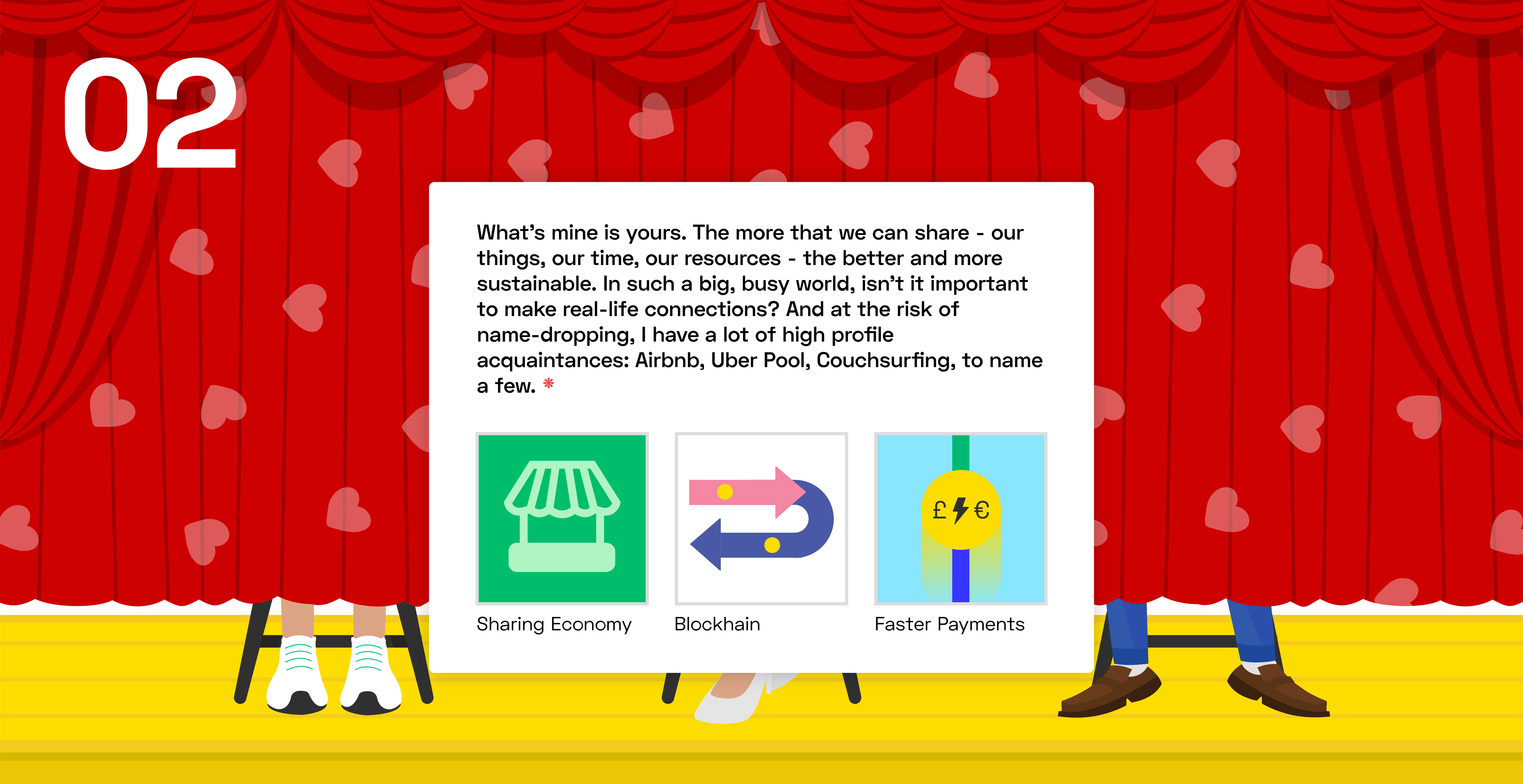\n\n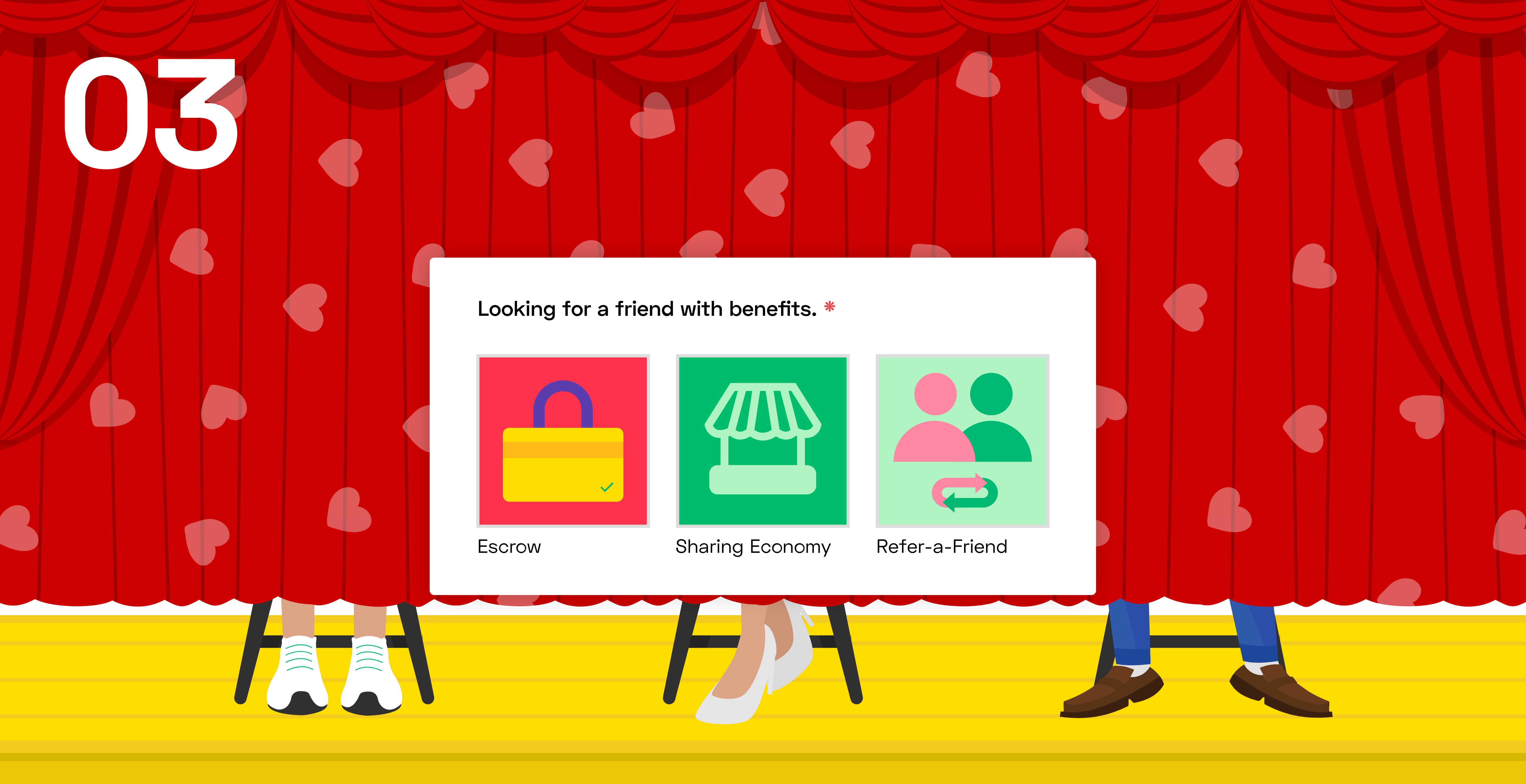\n\n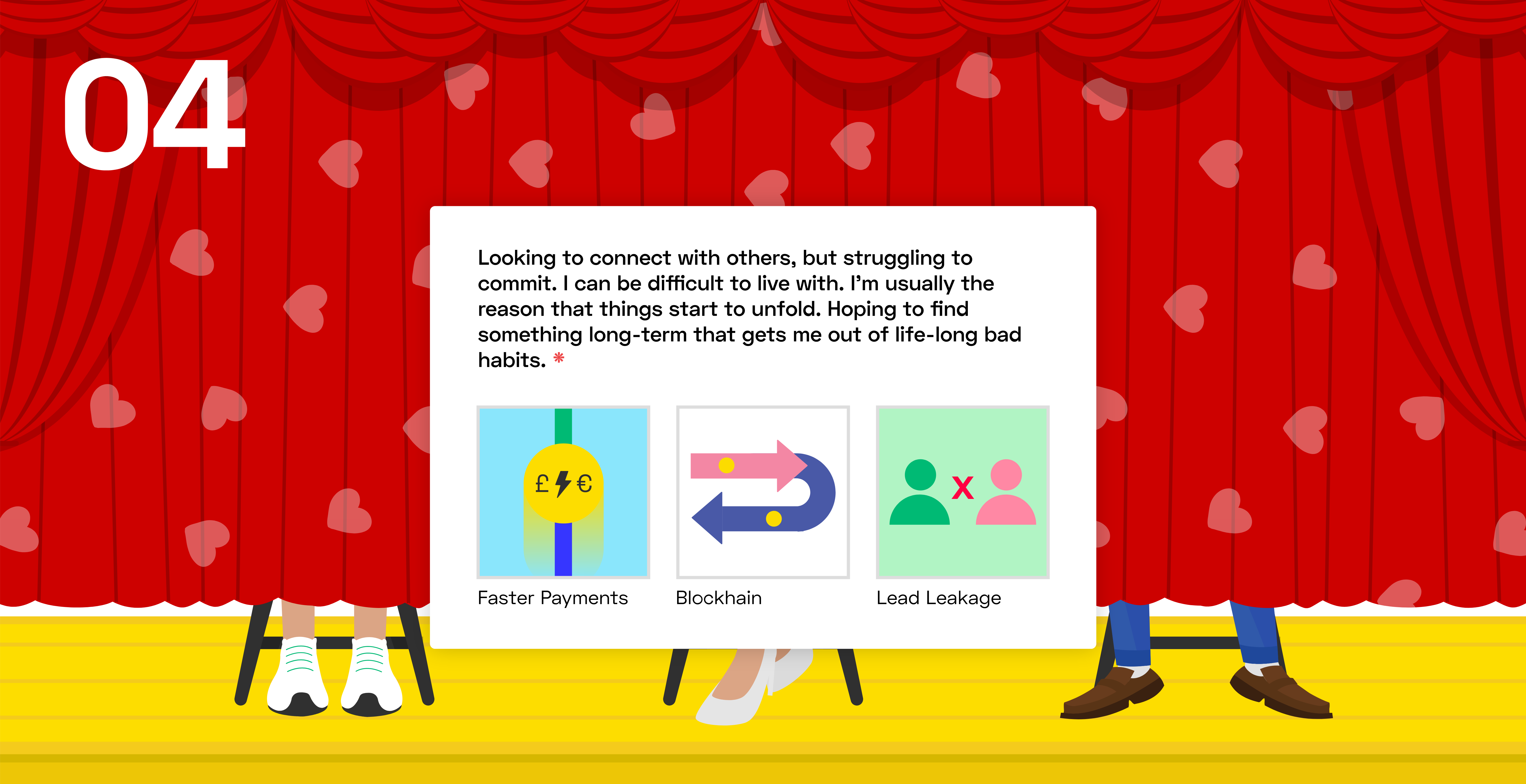\n\n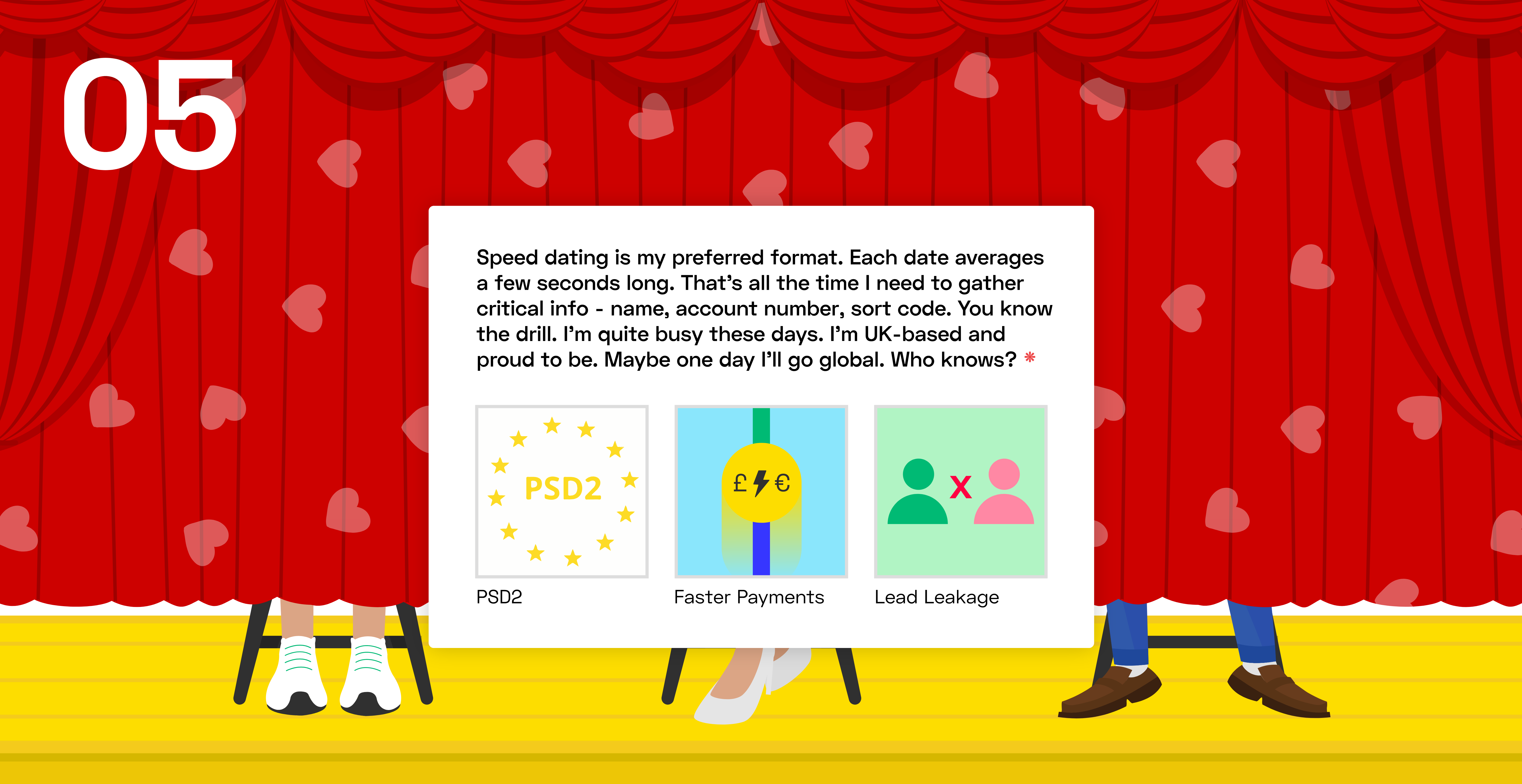\n\n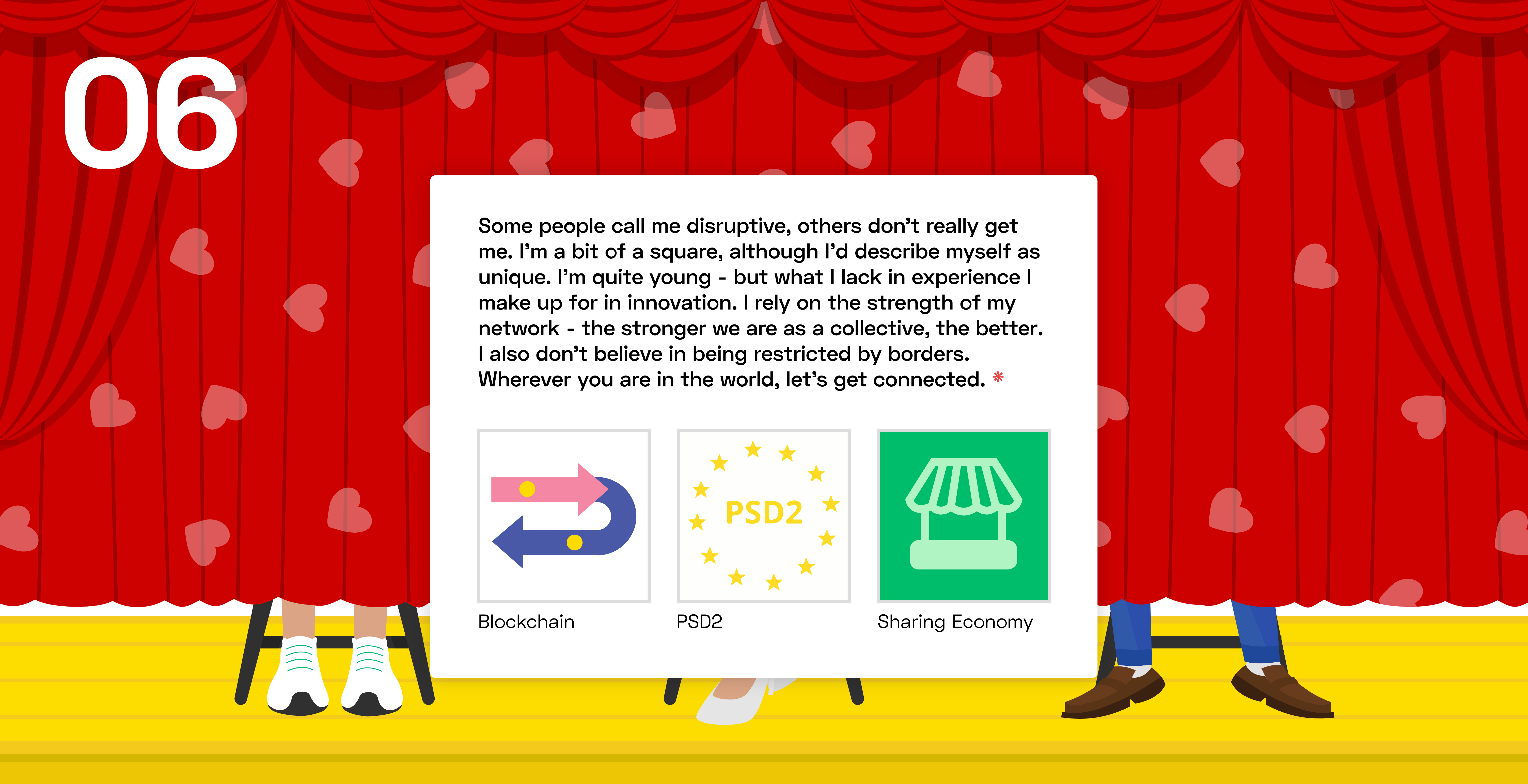\n\n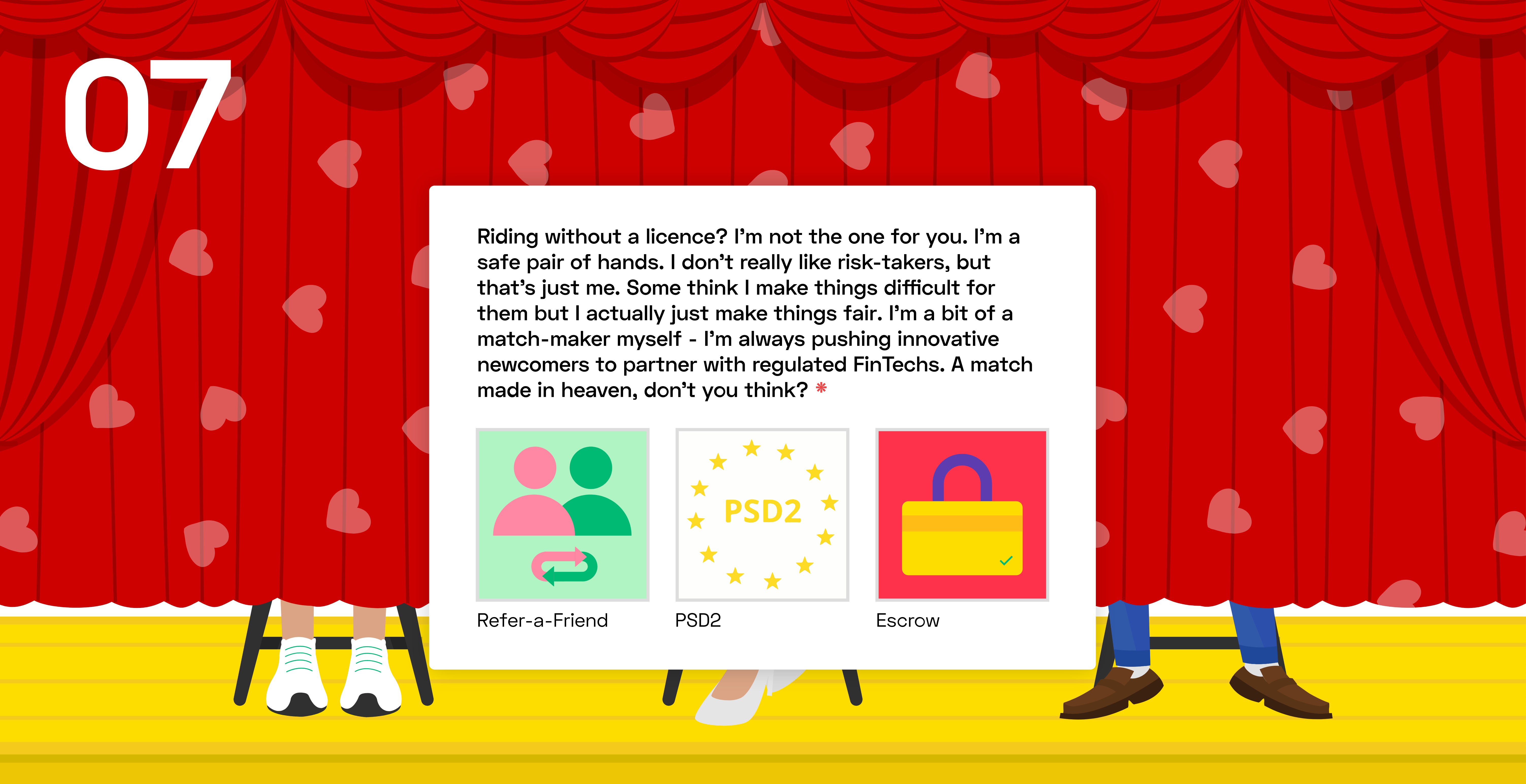\n\nIf you want to find out more about payments or any of the features mentioned in the quiz, [get in touch](https://www.paybase.io/get-in-touch) today!\n\n**ANSWERS**: 01. Escrow, 02. Sharing Economy, 03. Refer-a-Friend, 04. Lead Leakage, 05. Faster Payments, 06. Blockchain, 07. PSD2","excerpt":"How well do you know your industry? We’re putting you to the test in a very special FinTech edition of Blind Date. See if you can match these seven FinTech Valentine’s hopefuls with their perfect features, terms and instruments. The more you get righ...","cover":{"src":"https://paybase.imgix.net/blog/paper-heart.jpg","alt":"need one"},"link":{"to":"/blog/valentines-blind-date","copy":"Read more"},"tags":["FinTech","Valentine’s Day","Quiz"]},{"id":"cdd69e57-eedc-5a69-b339-406c3ded967e","title":"The A to Z of crypto jargon","slug":"crypto-jargon","published":"2020-01-31T00:00:00.000Z","author":"Gemma Doswell","content":"FUD, HODL, dApps and more - what does it all mean? There’s a lot of jargon in the cryptocurrency industry, and it’s difficult to make head and tail of it all. We’ve compiled a comprehensive list of terms, early pioneers of the crypto industry and acronyms that will help you begin to make your way through the confusion.\n\n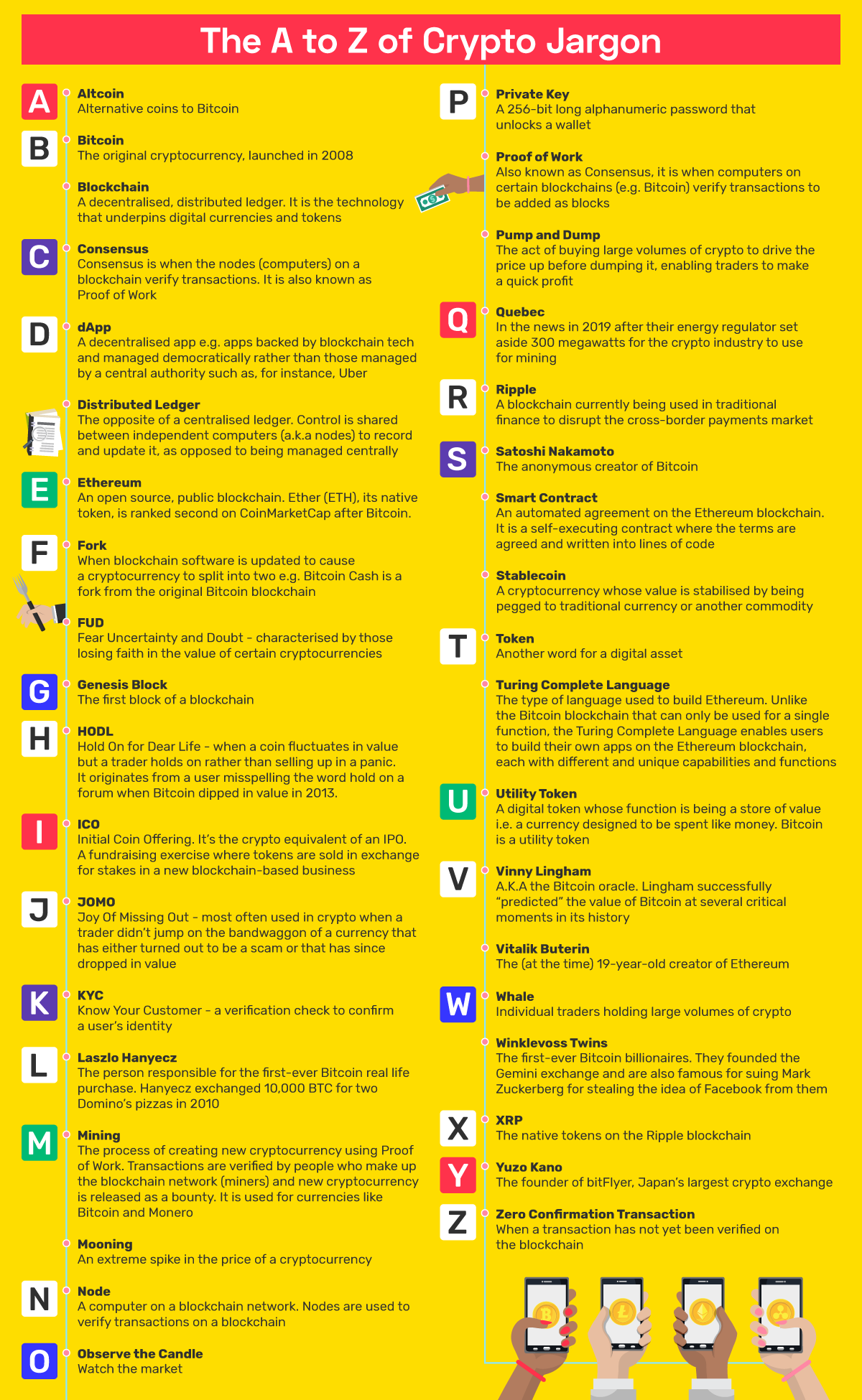","excerpt":"FUD, HODL, dApps and more - what does it all mean? There’s a lot of jargon in the cryptocurrency industry, and it’s difficult to make head and tail of it all. We’ve compiled a comprehensive list of terms, early pioneers of the crypto industry and acr...","cover":{"src":"https://paybase.imgix.net/blog/spelling-blocks.jpg","alt":"need one"},"link":{"to":"/blog/crypto-jargon","copy":"Read more"},"tags":["Cryptocurrency","Digital Currency","Payments"]}]}}}
 \n
\n